
Moray Grand Tour: Beaches And Castles
What Is The Moray Beaches And Castles Tour?
The Beaches and Castles tour explores the wild northern coastline and historic fortresses of Moray.
This scenic route spans over 2,000 years of history and features Brodie Castle, the vast dunes of Lossiemouth, and the world-renowned dolphin spotting at Spey Bay.
Whether you are joining us for this single leg or completing the full Moray Grand Tour itinerary, this route promises a world-class blend of medieval power seats, Pictish mysteries, and pristine coastal wilderness.
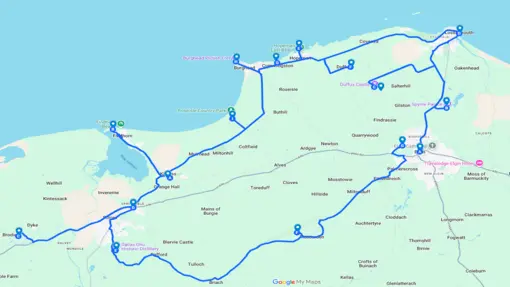
- Route Type: Circular Loop (Starts/Ends in Elgin)
- Total Driving Time: ~2 hours (pure driving time)
- Recommended Duration: 6–8 hours (full day)
- Roads Used: A941, B9135, B9012, B9040, B9089, B9011, A96, B9010.
Phase 1: The Bishop’s Lands & Royal Ruins
Elgin to Spynie Palace & Duffus Castle (~20 mins total via A941/B9135/B9012)
The Sights:
- Spynie Palace: Once the grandest castle in the north, this was the fortified residence of the Bishops of Moray for 500 years. Climb David’s Tower—one of Scotland’s largest surviving tower houses—for a bird’s-eye view of the “Laich o’ Moray.”
- Duffus Castle: A breathtaking 12th-century motte-and-bailey fortress. Originally built of wood and later stone, you can today explore the fractured keep that has dramatically slid down the hill over the centuries.
Did You Know?
- A Sinking Fortress: At Duffus Castle, you can see where a massive section of the stone keep has literally slid down the hill (the motte) over the centuries, leaving walls leaning at dramatic angles.
- The Bishop’s Skyscraper: David’s Tower at Spynie Palace was originally five floors high, making it one of Scotland’s largest tower houses and the biggest surviving medieval Bishop’s residence.
- Lost Sea Loch: What is now the inland Loch Spynie was once a sea loch, providing the Bishops of Moray with direct boat access and a safe place to anchor their ships right at the palace gates.
- Royal Incentives: Duffus Castle was built in 1140 by Freskin, a Flemish immigrant who was lured to Moray by King David I with the promise of land in exchange for settling the region.
- Five Centuries of Luxury: While the Cathedral moved to Elgin, the Bishops of Moray continued to live at Spynie Palace for over 500 years, only leaving in 1686.
Top Tips:
- Don’t Skip the Stairs: The climb to the top of David’s Tower at Spynie Palace is steep, but the panoramic views across Moray are some of the best in the area.
- Perfect Picnic Spot: Duffus Castle is widely considered the finest “motte-and-bailey” castle in Scotland; its wide grassy banks and quiet atmosphere make it a perfect spot for an outdoor lunch.
- Look for the “Slip”: When approaching the stone tower at Duffus, look for the massive cracks and tilted masonry—it’s a rare chance to see how medieval engineering struggled with the weight of stone on earth mounds.
- Combine the Two: These sites are only a few miles apart. Visiting them together gives you a complete picture of how the Lords and Bishops of Moray lived side-by-side in the Middle Ages.
- Birdwatcher’s Delight: Since Spynie Palace sits on the edge of the modern loch, bring binoculars to spot the diverse birdlife that has replaced the medieval sailors.
Family-Friendly Features: Duffus Castle is a giant green playground; the wide-open grassy motte is perfect for kids to burn off energy climbing the safe lower embankments.
The Natural Break: Grab an artisan coffee at Kula Coffee Hut, located right in the Duffus Castle car park.
Want To Know More?
Step back into a world of medieval power
SPYNIE PALACE
- Just North of Elgin, on the edge of Loch Spynie, is Spynie Palace. The Bishops of Moray enjoyed using the fortified residence, at the centre of a thriving community, for more than five centuries.
- Loch Spynie was originally a sea loch that provided direct access and safe anchorage.
- Giric or Gregory first appears, in the records, as Bishop of Moray as early as 1120.
- Bishop Brice chose Spynie church as his cathedral in 1207, and whilst the seat of Bishop was eventually moved to the Cathedral at Elgin, Spynie Palace remained the residence of the Bishop until 1686.
- The original buildings would have been built of timber. Changes to the layout and structure of the Palace up to the 16th century were extensive and reflected in the fortified residence as it appears today.
- The impressive David’s Tower originally contained five floors. It is one of Scotlands’ largest tower houses and the largest surviving medieval Bishop’s house.
- The 17th century, with its conflict and ecclesiastical uncertainty, ultimately led to the physical decline of the Palace.
- That said, the Palace still exudes grandeur on a scale rarely seen in medieval times.
- The view of Moray from the top of the tower is worth the climb.
DUFFUS CASTLE
- Duffus Castle is a Norman castle. The elevated mound, parapet, drawbridge and moat are typical of the defensive structures built at the time.
- The finest of its type in Scotland, the castle is located on what was once the northwestern shore of the Loch of Spynie.
- The land was granted to Freskin, Lord of Strathbock, by King David I. Freskin was one of the Flemish and Anglo-Norman immigrants encouraged, by the King, to settle in Moray with the promise of landed fiefs.
- The castle was built in 1140.
- During the Wars of Independence, the castle remained loyal to the English King Edward I. It was attacked and burnt down by the Scots in 1297.
- A stone tower was built on the motte as part of the rebuild in the 14th century. A stone curtain wall was built to replace the original wooden palisade.
- The tower was, and still is, one of Scotland’s most impressive stone towers.
- On approaching the castle, it is clear that a considerable part of the stone keep has slid down the motte. Parts of the curtain wall on the southeast side of the Bailey are leaning out at an angle.
- Much of the castle, however, is well preserved and presents an opportunity for the visitor to see one of the oldest surviving strongholds in Scotland.
Phase 2: The Jewel of the North & Coastal Cliffs
Duffus to Lossiemouth, Hopeman & Burghead (~25 mins total via B9040)
The Sights:
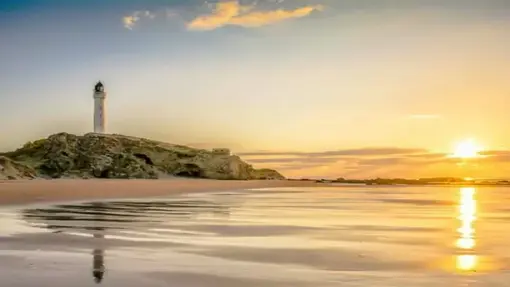
- Lossiemouth: Known as the “Jewel of the North,” this town boasts two spectacular beaches. The East Beach is a premier spot for watching the Moray Firth’s resident dolphins, while the Covesea Lighthouse (built 1846) stands guard to the west.
- Hopeman & Cummingston: Hopeman’s East Beach is famous for its vibrant, multi-coloured beach huts and “Daisy Rock” fossils. A short walk west leads to Cummingston, where the cliffs are riddled with sea caves and rock stacks.
- St Peter’s Kirk: Tucked away in the fields near Duffus, this 13th-century parish church is a photographer’s dream, featuring a unique leaning tower and a peaceful, ancient graveyard.
- Burghead: This headland once held the largest Pictish Fort in Scotland. Visit the Burghead Well, a mysterious rock-cut chamber likely used for ancient ritual drownings or baptisms.
Did You Know?
Dinosaur Tracks: You can see actual prehistoric dinosaur footprints preserved along the beach path and at the pavilion in Hopeman.
The Burning of the Clavie: Burghead keeps ancient Pictish traditions alive with an annual fire ritual that is revered globally.
A Presidential Connection: Lossiemouth is the birthplace of Ramsay Macdonald, the very first Labour Party Prime Minister.
Hidden Worship: Clashach Cove was once a secret place of worship for 5th-century Druids among its massive rock formations.
Royal Restoration: After St Peter’s Kirk was burned during the War of Independence, King Edward I personally granted 200 oaks to help rebuild it.
Smugglers’ Haven: During the 17th century, the Caves of Caussie at Cummingston were used by smugglers to hide goods financed by Elgin merchants.
Bouldering Hub: The sandstone cliffs at Cummingston are widely considered to offer the best bouldering in Scotland.
Top Tips:
Dolphin Spotting: Head to the Burghead visitor centre (the old Coastguard lookout) or the Hopeman harbour wall for the best vantage points to see the Moray Firth bottlenose dolphins.
Walk the Trail: Use the disused railway line at Cummingston for a flat, scenic route perfect for cyclists and walkers; it connects directly to the Moray Coastal Trail.
Instagram-Ready Huts: Visit the beach path at Hopeman to see a collection of individually painted beach huts, often cited as the best-looking huts in Scotland.
Healing Waters: Look for the Bramou Well on the boundary of Hopeman Lodge—local lore says its waters have healing powers.
Cross the Bridge: To experience the most impressive sand dunes in the area, use the pedestrian bridge in Lossiemouth to reach the expansive East Beach.
History at the Gates: You can find the remarkably well-preserved St Peter’s Kirk right at the entrance to the famous Gordonstoun School.
Family-Friendly Features: Hopeman East Beach features a large adventure playground and smooth paths perfect for scooters. The Burghead Visitor Centre has “touch and feel” displays for kids.
The Natural Break: Stop for lunch at The Harbour Lights (Lossiemouth) for marina views or the renowned The Bothy Bistro (Burghead) for fresh local seafood.
Want To Know More?
Experience the rugged soul of the Moray coast
LOSSIEMOUTH
- A well established port town, Lossiemouth has numerous examples of fine architecture from different centuries.
- The town was built originally as a port to service Elgin and its trade. Spynie was, for many centuries, the original port for Elgin. However, the entrance to Loch Spynie became blocked, over time, by sand and shingle.
- Lossiemouth today has retained much of its original layout, with wide streets separating the many small fishing cottages.
- The first Prime Minister from the Labour Party, Ramsay Macdonald is Lossiemouth’s famous son.
- In addition to the harbour, regular town plan and famous inhabitants, the visitor is presented with two beaches. Two beaches that are simply breathtaking.
- With its impressive sand dunes, the East Beach is reached by a pedestrian bridge.
- The landing lights of RAF Lossiemouth and the headland housing Covesea Lighthouse are features of a three mile stretch of beach at West Bay.
- Lossiemouth offers history, good dining opportunities, diversity and two beaches that offer something for everyone to see and do.
HOPEMAN
- Two excellent beaches, a druids site, prehistoric footprints and excellent wildlife. Just some of the features awaiting visitors to this fishing village.
- Originally built to house people displaced by the Highland clearance in the 19th century, the village has an active harbour that divides the east and west beach.
- Excellent rock pools and large grassy sand dunes are striking features of the East Beach
- Evidence of prehistoric dinosaur footprints can be found on the beach path and at the pavilion. The path leads to the individually painted beach huts that are, collectively, the best of any beach in Moray or Scotland.
- Overlooking the beach path is Hopeman Lodge. Where its boundary meets the beach path there is the Bramou Well, which is said to have healing powers.
- Following the beach path beyond the edge of the east beach provides access to Clashach Cove. A hidden beach and collection of large rock formations used in the 5th century, by the druids, as a place of worship.
- The beach path and harbour wall provide a perfect vantage point to see the Moray Firth bottlenose dolphins and a wide range of sea birds including, oyster catchers and black headed gulls.
CUMMINGSTON
- Designated a site of Special Scientific Interest, the sandstone cliffs and the Caves of Caussie are a feature of this small coastal village.
- Seaview Road provides access to a car park and beach which, for many visitors, remains one of the undiscovered parts of Moray.
- Access to the beach is via a footpath that also provides access to the wells that once provided water supply to the village.
- The caves were used for smuggling, by tinkers or Scottish gypsies, during the 17th century. Activities financed by the merchants in Elgin.
- Today, the caves and sandstone are used for climbing and provide the best bouldering in Scotland.
- The disused railway line, which runs parallel with the beach, is popular with walkers and cyclists. It is now part of the Moray Coast Trail network.
- A footpath provides access to the beach and the wells that once provided the village water supply.
- Parts of the sandstone cliffs at Cummingston are designated a Site of Special Scientific Interest.
ST PETER’S KIRK
- In medieval times, the building of a castle also required the founding of a church or kirk. Records from as early as 1226 confirm that the Lairds at castle Duffus, chose St Peter’s as the location for their church.
- The church had an altar of St Catherine and a chapel dedicated to St Laurence.
- When the Scots burned the castle at Duffus during the War of Independence, it’s no surprise that they also burned the church. Despite the loss of castle and church, the then Laird, Sir Reginald de Cheyne, remained faithful to King Edward I.
- In recognition of the continued loyalty, the King made a grant of 200 oaks from the forests of Longmorn and Darnaway to help restore the two buildings.
- In 1524, Alexander Sutherland added the gothic porch, with groined vault that now forms the entrance to the church. The Sutherland burial vault sits within the remains of what was once a medieval tower.
- To the South are some excellent examples of 16th century table-tombs and the market cross, the St Peter’s Cross.
- A substantial building with walls in excellent condition, St Peter’s Kirk is sited at the entrance to Gordonstoun School.
BURGHEAD
- A stronghold on the Moray coast, the largest Iron Age defensive structure in Britain was built in the 4th century by the Picts.
- Likely to be the Pictish capital of Fortriu it housed a Royal Palace. Pictish tradition is kept alive today with the annual burning of the Clavie.
- A unique Scottish signature event, the annual burning of the Clavie is a Pictish ritual that is revered on a global level.
- The Earl of Orkney, Sigurd the Powerful, captured the stronghold in 884. Known to the Vikings as Torridon, it remained a base of operations until retaken by the Scots in 1010.
- A much larger settlement and fishing port was developed in 1805. Thomas Telford was commissioned to build the harbour and warehouses.
- As part of the development, much of the ancient fort was destroyed. Only the “Burghead Bulls”, Pictish symbol stones, and the Burghead Well, discovered as part of the works, now remain.
- The Coastguard lookout is now a visitor centre and is a perfect lookout for the Moray dolphins.
Phase 3: Forests, Foundations & Forres
Burghead to Roseisle, Findhorn & Brodie Castle (~30 mins total via B9089/B9011/A96)
The Sights:
- Roseisle Forest: This coastal woodland blends pine-scented trails with golden sands. Look for the remains of WWII coastal defences and use the wildlife hides to spot seals and red squirrels.
- Findhorn: Explore the traditional village or the world-renowned Findhorn Foundation, an eco-village famous for its “whisky barrel” houses and sustainable living.
- Kinloss Abbey: Founded in 1150, these Cistercian ruins offer a quiet, reflective stop amongst atmospheric arches.
- Brodie Castle: A National Trust for Scotland treasure featuring a 16th-century tower house and a National Collection of over 400 varieties of daffodils.
Did You Know?
Royal Guest List: Over the centuries, Kinloss Abbey hosted some of history’s biggest names, including Edward I (“Hammer of the Scots”), Robert the Bruce, and Mary Queen of Scots.
A “Stolen” Abbey: In 1650, the stones from the ruined Kinloss Abbey were actually sold to Oliver Cromwell to help build his citadel in Inverness.
Pictish Records: The grounds of Brodie Castle house the Rodney Stone, a monument featuring the longest Pictish inscription ever discovered.
Macbeth’s Connection: Brodie Castle was built right next to Macbeth’s Hillock, the legendary spot where Macbeth is said to have encountered the three witches.
Ancient Pub: The Crown and Anchor Inn in Findhorn is the oldest surviving structure in the village, welcoming locals and travellers since 1739.
World-Famous Community: Findhorn is known globally as the birthplace of the Findhorn Foundation, an international centre for spiritual and environmental education.
Top Tips:
Watch for Wildlife: Use the dedicated wildlife hide at Roseisle Forest; it’s a peaceful spot to catch a glimpse of the animals that call the pine woods home.
Step Into the Ice Age: Visit the Ice House Heritage Centre in Findhorn to see how the village’s commercial fishing past was preserved.
Explore Secret Passages: When touring Brodie Castle, look out for the hidden passages and the 16th-century vaulted guardroom tucked away in the towers.
Beach BBQ: Roseisle is perfectly set up for a full day out—it has barbecue equipment and play areas right by the beach, sheltered by the Scots pines.
Seals and Sails: Head to Findhorn Bay if you’re a fan of watersports; it’s a major sailing hub and one of the best spots to see seals lounging on the sandbars.
Walk the Trails: Take advantage of the three main trails through Roseisle Forest, which offer great shelter for cycling even on breezier coastal days.
Family-Friendly Features: Brodie Castle is home to the “Playful Garden,” featuring a 6.5-metre-tall rabbit, musical instruments, and interactive water play.
The Natural Break: Brodie Countryfare is an institution for family dining, famous for its traditional Scottish Afternoon Tea.
Want To Know More?
Uncover a landscape of sanctuary and power
ROSEISLE
- Roseisle forest and beach sits between Burghead and Findhorn on Burghead Bay.
- With views across the Moray Firth and accessed through scots pine trees, the sandy beach is sheltered by sand dunes.
- It provides a great platform to observe seals and dolphins at play.
- The woods provide shelter for cycling and walking along the 3 main trails.
- A natural haven for wildlife, the woods have an area with wildlife hide, play and barbeque equipment and toilets.
FINDHORN
- A superb beach, picturesque bay and attractive village await the visitor to Findhorn.
- Once an important commercial seaport, much of the herring fishing and salmon industry was in decline by the end of the 20th century.
- A glimpse of the commercial past can be found at the Ice House Heritage Centre and the oldest surviving structure in the village, the Crown and Anchor Inn, which dates back to 1739.
- Transformed over the years into a peaceful haven, Findhorn is better known, internationally, as the home of the Findhorn Foundation.
- Today Findhorn is a major watersports and sailing centre. In addition there are plenty of opportunities to enjoy the seals, dolphins and great variety of birds along this stretch of the Moray Firth.
KINLOSS ABBEY
- Kinloss Abbey is a Scheduled Ancient Monument and Grade A Listed Building.
- Founded by King David I in 1150 for Cistercian monks of Melrose Abbey, its significance, in the history of the North East of Scotland, is considerable.
- As a Cistercian house of considerable wealth and size, the Abbey received many Royal endowments and visitors.
- In 1303, Edward I (the ‘Hammer of the Scots’) camped at Kinloss Abbey as part of his tour of surpression.
- Salmon fishing rights to the Findhorn were granted by Robert I (The Bruce) in 1312.
- Edward III was a guest in 1336 and Mary Queen of Scots stayed in the Abbey in 1562.
- In 1560, The Reformation of Parliament signaled the end for the Abbey. The wealth and fabric of the abbey was stripped by the last Abbot and the stone of the ruined building was sold to Cromwell in 1650.
BRODIE CASTLE
- Now in National Trust ownership, Brodie Castle was built close to Macbeth’s Hillock, in 1567, by Clan Brodie
- Architecturally, the castle has a very well preserved central keep with two 5-storey towers on opposing corners. It includes a 16th century vaulted guardroom and secret passages.
- Priceless antiques and unique artifacts can be found in the towers and rooms of this grand Scots Baronial mansion.
- In the grounds there is the Rodney Stone, a Pictish monument with the longest pictish inscription found too date.
Phase 4: The Spritual Return & Finale
Forres to Dallas Dhu & Pluscarden Abbey (~25 mins via B9010)
The Sights:
- Sueno’s Stone: Standing over 20 feet high, this is Scotland’s tallest Pictish monument, carved with incredibly intricate 9th-century battle scenes.
- Dallas Dhu Distillery: A Victorian “time capsule” distillery. Preserved exactly as it was when it closed in 1983, it offers a unique look at the traditional craft of Scotch Whisky.
- Pluscarden Abbey: Tucked away in the secluded Vale of St Andrew, this is the only medieval monastery in Britain still inhabited by monks. Visitors can hear Gregorian chants daily.
- Quarrelwood: End your journey on the outskirts of Elgin. A short uphill walk through ancient oak woods leads to a prehistoric hill fort with panoramic views over the Moray Firth to the hills of Sutherland.
Did You Know?
The Real Macbeth: Forres was the seat of the real King Macbeth, who ruled Moray from the castle here and set out from the town to defeat King Duncan I in battle.
The World’s Largest Pictish Stone: Standing over 6.5 metres tall, Sueno’s Stone is the largest surviving Pictish stone in the world and the largest sculptured stone in Europe.
A Living Medieval Monastery: Pluscarden Abbey is unique in Britain as the only medieval monastery still used for its original purpose and inhabited by monks today.
Shakespearean Inspiration: The grim history of the Witches Stone—where three women were rolled down Cluny Hill in barrels in 962—is said to have inspired the “weird sisters” in Shakespeare’s Macbeth.
Whisky Time Capsule: Dallas Dhu stopped production in 1983, but because its methods never changed since 1899, it remains a perfectly preserved “time capsule” of Victorian distilling.
A Stolen Abbey: During its 17th-century decline, Pluscarden was used as a quarry; its stones were taken to help rebuild St Giles Kirk in nearby Elgin.
Top Tips:
Spot the Battle Panels: When visiting Sueno’s Stone, look closely at the horizontal panels; they tell a narrative of a massive ancient battle, possibly between Vikings and Picts.
Climb for the View: After visiting Dallas Dhu, head to the nearby Califer Hill viewpoint for some of the best panoramic views over the Moray Firth and the Black Isle.
Walk the “Wynds”: Take a stroll off the Forres High Street to explore the original medieval “wynds” and “pends” (narrow alleys and arched walkways) that still follow the town’s ancient street plan.
See the Sculptures: Don’t miss the sunken garden at Grant Park, which is famous for its intricate and award-winning floral sculptures.
Find the Henge: For a hidden prehistoric gem, head to the Quarrelwood Henge located within the Forestry Commission plantation on the edge of Elgin.
Respect the Silence: If you visit Pluscarden Abbey, remember it is an active monastery; it’s a wonderful place to experience the same peaceful atmosphere monks have enjoyed since 1230.
Family-Friendly Features: Dallas Dhu is great for kids because it is a quiet museum rather than a noisy, hot factory. Quarrelwood’s forest paths are perfect for “fairy-tale” explorations.
The Natural Break: On the B9010 return leg, stop at The Snug (Alves) for a cosy, home-baked treat.
Want To Know More?
Journey into the heart of Scottish legend
FORRES
- The ancient royal burgh of Forres has strong links with Macbeth.
- Macbeth ruled Moray from the castle in Forres. From Forres, he set out to meet and kill King Duncan I in battle.
- The monument to Dr James Thomson on Castle Hill marks the location of the original castle.
- The town retains its original medieval street plan with “wynds” and “pends” off the High Street.
- Near the centre of the town is the townhouse, built in 1839 on the site of the old toll booth and Mercat cross.
- The fine buildings in the town centre confirm the role as a principal market town.
- Forres’s history and comprehensive archive can be found at the Falconer Museum.
- The impressive St Laurence Church is nearby.
- The Witches Stone is one of three original stones that marked where three witches were put to death in 962. They had been accused of plotting the death of King Dubh. They were rolled down Cluny Hill in barrels and burnt at the point that they came to rest.
- In 967, the governor of Forres, Donwald, is believed to have murdered King Dubh before moving the body to Kinloss bridge, where it was hidden.
- It is said that this account, with the murder of Dubh and the burning of the three witches, inspired Shakespeare’s play.
- The sunken garden at Grant Park is home to award-winning floral sculptures. Nearby is Nelson Tower, built to commemorate the death of Nelson at Trafalgar.
- Forres is one of the oldest towns in Scotland and was once one of the most important places in Scotland.
SUENO’S STONE
- The largest surviving Pictish stone in the world and the largest sculptured stone in Europe.
- Sueno’s Stone dates back to the end of the first millennium and stands over 6.5m high.
- The front and rear faces of the stone, and its sides, are covered in intricate carvings that depict a battle.
- Displayed one above another, the battle is told in a series of horizontal strips set within panels.
- There are many views on the battle that the stone records.
- An encounter between Viking and Picts or Viking and Scots. Or the battle known to have been fought at Forres in 966 in which King Dubh or Duff of Alba fought for control over Moray.
- The arched structure, shown on the stone, could be the bridge under which Dubh’s body was hidden after his murder, by Donwald, in 967.
DALLAS DHU
- The picturesque distillery of Dallas Dhu was built in 1898 to produce malt whisky for blending.
- Charles Doing, a Scottish architect, designed the distinctive pagoda roof.
- Dallas Dhu is unique amongst Scottish distilleries. The last barrel of whisky produced by the distillery was in 1983. However, the distilling process was the same as the first barrel produced in 1899. It provides a rare opportunity to experience how a distillery would have looked and operated over a century ago.
- Historic Scotland now maintains the distillery as a working museum, and it has secured a unique role in promoting the whisky heritage.
- Its location is close to Califer Hill viewpoint. A picnic site with extensive views over the Moray Firth and the Black Isle.
PLUSCARDEN ABBEY
- Founded by King Alexander III in 1230, the Abbey is the only medieval monastery in Britain still used for its original purpose and inhabited by monks.
- The stained glass windows of the Choir were the first of its scale anywhere in Scotland and a medieval wonder.
- The Wolf of Badenoch set fire to the Abbey in 1390. The damage much reduced the Choir windows.
- In 1454, Pluscarden Priory became a Benedictine Housefollowing a merger with the priory of Urquhart.
- The decline of the priory during the 17th century, linked to the Scottish Reformation, resulted in the priory becoming ruinous. It was used as a quarry to rebuild St Giles Kirk in Elgin.
- The turning point was the restoration and transfer of the buildings to the Benedictine community of Prinknash Abbey in 1948.
- The priory, and in no small part due to the ongoing restoration by the monks, was raised to Abbey status in 1974.
QUARRELWOOD HENGE
- A ‘henge’ is simply an earthen enclosure, usually composed of one or more circular banks and ditches.
- The Quarrelwood henge is located within a Forestry Commission plantation on the western fringe of Elgin and built near the crest of a hill.
- An oval bank and ditch create the enclosure, with the outer slope formed by the bank. A break in the bank on the west side forms an entrance.
Best For Photographers: Top 3 Vantage Points
If you’re looking to capture the “perfect shot” of Moray, don’t miss these three iconic locations:
1. The Leaning Tower of St Peter’s Kirk
The Shot: The dramatic tilt of the 13th-century bell tower against a backdrop of open fields.
Pro Tip: Visit during the “Golden Hour” (just before sunset). The low sun hits the weathered stone and highlights the textures of the ancient gravestones, creating a hauntingly beautiful, gothic atmosphere.
2. The Hopeman Beach Huts
The Shot: A symmetrical line of brightly painted, multi-coloured wooden huts contrasting with the golden sand and blue Moray Firth.
Pro Tip: Use a wide-angle lens to capture the full row of huts. If you’re lucky, you can time your shot to include the Covesea Lighthouse in the far distance for a classic “British Seaside” composition.
3. The Summit of David’s Tower (Spynie Palace)
The Shot: A 360-degree panoramic view of the “Laich o’ Moray.” From the top of this 15th-century tower, you can see the shimmering waters of Spynie Loch and the distant peaks of the Highlands.
Pro Tip: This is the best spot for landscape photography. Use a telephoto lens to compress the layers of the landscape, showing the relationship between the ancient ruins and the modern coastline.
Best For Wildlife: Top 3 Nature Spots
The Moray coast is a world-class destination for nature lovers. As you loop from the historic plains to the rugged shoreline, keep your eyes peeled for these iconic inhabitants:
1. Bottlenose Dolphins at Covesea & Hopeman
The Sighting: The Moray Firth is home to the world’s most northerly population of Bottlenose Dolphins. They are frequently spotted playing in the surf just offshore from the Covesea Lighthouse.
Pro Tip: Look for “disturbed water” or a gathering of seabirds. Dolphins are often seen breaching close to the cliffs where the water is deeper, allowing them to hunt more effectively.
2. Oystercatchers & Wading Birds at Findhorn Bay
The Sighting: This massive natural tidal basin is a vital stopover for thousands of migratory birds. The distinctive “peep-peep” of the black-and-white Oystercatcher is the soundtrack to the bay.
Pro Tip: Visit at low tide when the mudflats are exposed. Bring a pair of binoculars to the bird hide on the southern edge of the bay to spot Curlews, Knots, and—if you’re lucky—the occasional Osprey diving for fish.
3. Roe Deer at Roseisle Forest
The Sighting: The quiet, pine-scented tracks of Roseisle are home to elusive Roe Deer. They are most commonly seen in the clearings where the forest meets the dunes.
Pro Tip: Be the first on the trails in the early morning. Walk softly and keep downwind; these deer have incredible hearing and will disappear into the brush at the slightest snap of a twig.
Navigation & Visitor Tips
Public Toilets: Available at Lossiemouth, Hopeman, Burghead, Roseisle, and Findhorn.
Road Safety: The B9040 is scenic but can be narrow; take your time and use the passing places where necessary.
What’s Next? From Forres, you are perfectly placed to join the Speyside Trail or head east to explore the Fish to Farm coastal route toward Banffshire.
Let’s Start Something new Say Hello!
Your visitor experience is important to us. We can help with the information that you might need, before and during your visit, to make informed choices.