
Moray Grand Tour: Fish To Farm
What Is The Fish To Farm Tour In Moray?
The Fish to Farm tour is a coastal journey that follows the legendary River Spey from the grand estates of Fochabers to the dramatic coastline of Spey Bay, before heading east through the historic “Seatowns” and returning through the agricultural heart of Moray.
Highlights include the iconic Bow Fiddle Rock in Portknockie, the colourful harbour cottages of Cullen, and the fertile farmlands of the Spey valley. It is the best route for discovering authentic local seafood, maritime heritage, and ‘unfiltered’ coastal scenery.
- Route Type: Circular Loop (Starts/Ends in Elgin or Fochabers)
- Total Driving Time: ~1 hour 45 mins (pure driving time)
- Recommended Duration: 6–8 hours (full day)
- Roads Used: A96, B9104, A98, A942, B9018.

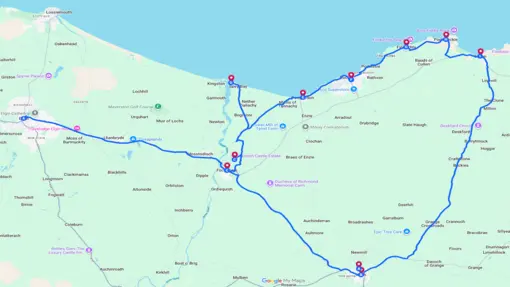
Phase 1: The Estate & The Estuary
Elgin to Spey Bay (~20 mins via A96/B9104)
The Sights:
- Fochabers: A beautiful 18th-century “planned village.” Stroll the wide main street, famous for its independent shops and the heritage of the Baxters food empire.
- Gordon Castle Walled Garden: One of the oldest and largest kitchen gardens in Britain. Explore the award-winning acres that provide fresh produce for the castle’s cafe and gin distillery.
- Spey Bay & WDC Scottish Dolphin Centre: The mouth of the River Spey. Visit the historic Tugnet Ice House, once the largest in Scotland, used to store salmon before the days of refrigeration.
Did You Know?- The “Scottish Versailles”: In the late 18th century, the 4th Duke of Gordon transformed Gordon Castle from a rugged fortress into a grand baronial mansion, earning it a reputation as a Scottish version of Versailles.
- A Giant of Ice: The Tugnet Icehouse at Spey Bay is the largest surviving icehouse in Scotland. It once served the local salmon fishing industry and now houses fascinating exhibitions.
- Royal Ancestry: The Gordon family lineage is exceptionally ancient, dating back to the 14th-century reign of King Robert the Bruce.
- National Treasure: The Walled Garden at Gordon Castle, which dates back to 1803, is officially recognised as a “work of art” and a garden of national significance.
- Musical Hub: The annual Speyfest in Fochabers attracts a worldwide audience every July for a three-day celebration of Celtic music.
Top Tips:
- Spot the Dolphins: Head to the Whale and Dolphin Conservation Society at Spey Bay for one of the best land-based vantage points in Scotland to see dolphins and whales in the wild.
- Time Your Visit for Festivals: If you love wildlife, plan your trip for May to catch the Really Wild Festival. For music lovers, the end of July is the peak time to experience Speyfest.
- Explore the Shingle: Take a walk along the Spey Bay coastal reserve to experience the largest shingle beach in Scotland, shaped by the ever-changing River Spey.
- Church Architecture: Don’t miss the fine Georgian church just south of Fochabers square; its clock tower has been a local landmark since 1798.
Family-Friendly Features: The Dolphin Centre features interactive exhibits and a “binocular hire” service, making it easy for kids to join the hunt for fins in the bay.
The Natural Break: The Gordon Castle Potting Shed offers seasonal lunches and “garden-to-plate” cakes right in the heart of the walled garden.
Want To Know More?
From baronial estates to coastal reserves
FOCHABERS
- An attractive town, Fochabers offers visitors a selection of very fine buildings.
- To the south of the square, and close to an impressive fountain, is a fine Georgian church complete with its clock tower dated 1798.
- A celebration of the best in traditional and contemporary Celtic music is captured at the annual Speyfest. The festival is held over three days at the end of July on the Fochabers playing fields and draws a worldwide audience.
- Baxters, a family-run company specialising in soup and preserves, has operated in Fochabers since 1868.
GORDON CASTLE
- The family of Gordon is an ancient clan whose lineage dates back to the reign of King Robert the Bruce in the 14th century.
- Records show that Sir Adam Gordon was at the Battle of Inverury in 1308 and fought alongside Robert the Bruce.
- George, Second Earl of Huntly, established a castle on the Estate in 1279.
- In the late 18th century, Alexander, the 4th Duke of Gordon, transformed the castle into a grand baronial mansion. The result starkly contrasted the original fortress and a Scottish Versailles in design.
- Evidence of a walled garden at Gordon Castle can be traced to the 17th century. In its present form, the Walled Garden dates back to 1803 and would have supplied the castle with vegetables, fruit and herbs.
- The Inventory of Gardens and Designed Landscapes in Scotland judged the Walled Garden as a work of art and an outstanding garden of national significance.
SPEY BAY
- Spey Bay is a coastal reserve. The wet woodland, coastal grassland, the largest shingle beach in Scotland and saltmarsh habitats have been shaped and created by the constant changing River Spey.
- The origins of Spey Bay can be linked to the salmon fishing on the Spey.
- The Tugnet icehouse is all that remains of the original fishing station and is the largest surviving icehouse in Scotland.
- Home to the Whale and Dolphin Conservation Society, it is a tourist attraction that offers exhibitions and a land-based whale and dolphin watching facility for all the family.
- The heritage, wildlife and scenic outdoors offered by this unique part of Moray are celebrated at the annual Really Wild Festival in May.
Phase 2: Seals & Seatowns
Spey Bay to Findochty (~25 mins via A98/A942)
The Sights:
- Portgordon: Famous for its resident seal colony. You can often see dozens of seals basking on the rocks just yards from the village harbour.
- Garmouth: Once a significant port dating back to the 16th century.
- Buckie Harbour: The industrial heart of Moray’s maritime history. Watch the working fishing boats and learn about the “drifter” heritage that built this bustling town.
- Findochty: Locally known as “The White Hythe,” this village is a rainbow of colourful “painted houses” surrounding a picturesque, historic harbour.
Did You Know?A Royal Welcome: King Charles II famously stepped ashore at Garmouth on 23 June 1650, where he signed the Covenant and the Solemn League in open defiance of Oliver Cromwell.
The Cathedral that Wasn’t: St Peter’s Church in Buckie was originally built in 1857 to serve as a Roman Catholic Cathedral. Although it never officially achieved that status, it remains a soaring Gothic masterpiece.
Wandering Wynds: Unlike the rigid, “planned” settlements found elsewhere in Moray, Garmouth features a charmingly random street pattern of traditional cottages.
Shipbuilding Secrets: Neighbouring Kingston was once a buzzing industrial hub for shipbuilding, supporting Garmouth’s role as a significant port dating back to the 16th century.
Active Heritage: Despite the general decline in fishing, Buckie Harbour remains one of the most active in Scotland and still operates a busy shipyard today.
Top Tips:
Look for the Plaque: When visiting Garmouth, keep an eye out for the commemorative plaque in the village that marks the exact spot of King Charles II’s historic arrival.
Scale the Ridge: For the best views of Buckie’s Victorian architecture, walk along the ridge behind the town to see how the “new” town was built high above the original fishing villages.
Spot the Spires: Use the twin spires of St Peter’s as your coastal compass—the church is so grand it can be seen for miles along the Moray Firth shoreline.
Harbour Walk: Head down to Buckie’s 1877 harbour in the morning to see the active shipyard in action and experience the pulse of a working Scottish port.
Family-Friendly Features: Seal watching at Portgordon is a low-effort, high-reward activity—the seals are almost always visible from the easy-to-access coastal path.
The Natural Break: Stop at The Admirals in Findochty for a quick snack with a view over the yachts and fishing boats in the marina.
Want To Know More
Step into the heart of Moray’s maritime heritage
GARMOUTH
- At first sight, it isn’t easy to imagine that there was a significant port dating back to the 16th century at Garmouth with a shipbuilding industry based at neighbouring Kingston village.
- Its significance as a port is underlined by the plaque in the village that commemorates the signing of the Covenant and the Solemn League (in defiance of Cromwell) by King Charles II immediately after coming ashore on 23 June 1650
- The random street pattern of attractive cottages and houses provides a welcome contrast to the planned settlements in Moray.
BUCKIE
- The Buckie that greets the visitor today was shaped by the Gordon family of Cluny in the late 18th century.
- Impressive Victorian architecture is evident within the town and is laid out along a ridge above and behind the original fishing villages.
- One such impressive building is St Peter’s Church, which can be seen for miles along the coastline.
- Initially built in 1857 to be a cathedral of the Roman Catholic Church, it never achieved the intended status. It remains a twin-spire gothic masterpiece and one of the most magnificent churches in the North East of Scotland.
- The harbour dates back to 1877 and, despite the decline in the Scottish fishing fleets, remains one of the most active in Scotland, with a busy shipyard.
Phase 3: Arches & Ancient Viaducts
Findochty to Cullen (~10 mins via A942)
The Sights:
- Bow Fiddle Rock: Witness Moray’s most iconic natural landmark at Portknockie. This quartzite sea arch resembles the tip of a fiddler’s bow emerging from the waves.
- Cullen Viaducts: Walk under the towering 19th-century railway viaducts that dominate the skyline of the “Seatown” fishing quarter.
- The Three Kings: Three massive rock stacks on Cullen beach, steeped in Viking legend and marking the site of the Battle of Bauds.
Did You Know?A Natural Masterpiece: The Bow Fiddle Rock in Portknockie gets its name from its unique shape, which resembles the tip of a fiddle bow.
Engineering Royalty: The historic pier and harbour in Cullen were designed by Thomas Telford, the same legendary engineer who built the Caledonian Canal.
A World-Famous Soup: Cullen is the birthplace of Cullen Skink, a hearty smoked haddock, potato, and onion soup that has become a staple of Scottish cuisine worldwide.
Centuries of History: The cliff-top village of Portknockie has been inhabited for over 300 years, with its roots stretching back to 1677.
Wildlife Hotspot: The waters around the Bow Fiddle Rock are a prime spot for sightings of bottlenose dolphins and diverse seabird colonies.
Top Tips:
Walk the Coast: Follow the cliff-top path west from Portknockie to find the best vantage points for photographing the Bow Fiddle Rock.
Taste the Original: You haven’t truly visited Cullen until you’ve tried a bowl of authentic Cullen Skink at one of the local harbour-front restaurants.
Perfect Picnic Spot: Head to the sandy beaches of Cullen Bay—the massive railway viaduct provides a stunning, dramatic backdrop for a family day out.
Explore the Marina: Spend some time at Portknockie Harbour; while it’s now a peaceful marina for private boats, you can still see the traces of its 19th-century herring boom.
Village Charm: Take a stroll through the Royal Burgh of Cullen to browse the independent shops and admire the traditional seatown architecture.
Family-Friendly Features: Cullen beach is a paradise for rock-pooling. The wide, sandy bay is perfect for kids to hunt for crabs and “sea glass.
“The Natural Break: No visit is complete without a bowl of world-famous Cullen Skink (smoked haddock soup) at the Lily’s Kitchen or the Cullen Bay Hotel.
Phase 4: The Agricultural Heart
Cullen to Keith & Return (~30 mins via B9018/A96)
The Sights:
- The Enzie: Drive through the rolling hills of the Enzie, the fertile agricultural belt that has supported Moray’s farming families for generations.
- Strathisla Distillery: Located in Keith, this is the oldest continuously operating distillery in the Highlands. Its twin pagodas are among the most photographed in the world.
- Keith: A friendly market town that celebrates its farming roots every year with the famous Keith Show.
Did You Know?Ancient Cattle Hub: Keith’s status as a major agricultural centre dates back to the 8th century, when it was a vital hub for the cattle trade.
The Oldest Dram: Strathisla Distillery is the oldest legally operating distillery in the Highlands, producing whisky since 1786.
Royal Gift: The altarpiece in the local Roman Catholic Chapel was a personal gift from King Charles X of France.
One-of-a-Kind Museum: Keith is home to the Scottish Tartans Museum, the only institution of its kind dedicated to the history of the cloth.
Dark Folklore: Near the churchyard in Fife Keith lies the Gaun Pot, a pool historically used for the drowning of accused witches.
A “Triple” Town: Modern Keith actually comprises three distinct communities: Keith, Fife Keith, and Newmill.
Top Tips:
Visit the Most Picturesque Distillery: Make time for a tour of Strathisla; it is widely considered the most beautiful distillery in Scotland thanks to its iconic twin pagodas.
Experience the Keith Show: If you’re visiting in the summer, check the dates for the Keith Country Show, the modern successor to the historic Great Simmareve Fair.
Learn a Traditional Craft: Stop by the Keith Kilt School to see students learning the intricate, vanishing art of hand-sewn kilt-making.
Walk the River Isla: Follow the banks of the River Isla to explore the area that fueled the town’s historical wealth from flax, barley, and wool.
Discover Tweed History: Visit the Isla Bank Mills area to see the site that served as the powerhouse of the local tweed industry for over 140 years.
Family-Friendly Features: The Keith & Dufftown Railway (The Whisky Line) offers seasonal heritage train rides that kids will love—check their schedule for “Ghost Trains” or “Santa Specials.
“The Natural Break: Square Roots in Keith serves hearty Highland portions of “Stovies”—the ultimate local comfort food.
Want To Know More
Step into a town built on the riches of the land
KEITH
- A Burgh of Barony in its early history and an important centre for the cattle trade in the 8th century, Keith is an agricultural town on the River Isla.
- An important business centre, the town now consists of 3 communities, Keith, Fife Keith and Newmill.
- Black cattle and horses were sold at the annual Great Simmareve Fair in mid-September. The fair attracted manufacturers and traders from Glasgow and merchants from the Highlands and Islands. The Keith Country Show eventually replaced the fair.
- Though farming methods today are somewhat different from those of our forefathers, the Keith Country Show still holds true to its agricultural roots.
- This can be seen by the variety of exhibitions, demonstrations and traders available within the showground.
- Historically, the cattle trade and the farming of barley, oats and flax created wealth fuelled by a local industry dominated by agriculture.
- The River Isla banks also formed the focus for a more enduring industry for Keith: distilling.
- There are four distilleries in Keith or its immediate area, and by far, its best know is Strathisla; it is also, by far, the most picturesque distillery in Scotland.
- The Stratisla distillery is also the oldest legally operating distillery in the Highlands, operating since 1786.
- Textiles were also an essential source of wealth. The ‘Cottage Industry’ of spinning and weaving gave way to a more structured method of large-scale woollen mills.
- The Isla Bank Mills to the north of the town were a centre for the tweed industry from the 1850s until the 1990s and are now home to a successful business park.
- At the Keith Kilt School, students are taught the art of kilt-making, and the Scottish Tartans Museum is the only one of its kind.
- The Roman Catholic Chapel has two colossal figures of St. Peter and St. Paul surmounting the pediment and an altarpiece presented by Charles X of France.
- Near the churchyard of Fife Keith is the Gaun Pot or Pool in which witches were drowned.
- With its agriculture, distilleries, and many specialised manufacturers that formed its industrial heritage, coupled with hill and nature walks on its doorstep, Keith lends itself to service industries and tourism.
Best For Photographers: Top 3 Vantage Points
If you’re looking to capture the “perfect shot” of Moray, don’t miss these three iconic locations:
1. Bow Fiddle Rock (Portknockie)
The Shot: The iconic sea arch framed against a crashing North Sea.
Pro Tip: Use a fast shutter speed to freeze the spray as it hits the rocks, or visit at low tide to walk closer to the arch for a dramatic “worm’s eye” perspective.
2. The Twin Pagodas of Strathisla (Keith)
The Shot: The perfectly symmetrical distillery roofs reflected in the Linn Pot of the River Isla.
Pro Tip: This is one of the most aesthetic distilleries in Scotland. Use the river in the foreground to create a leading line straight to the historic architecture.
3. The Cullen Viaduct Walk
The Shot: A panoramic view of the colourful Seatown houses nestled beneath the massive stone arches of the former railway line.
Pro Tip: Climb the path onto the top of the viaduct itself for an elevated view of the Moray Firth and the “Three Kings” rock stacks.
Best For Wildlife: Top 3 Nature Spots
The Moray coast is a world-class destination for nature lovers. As you loop from the historic plains to the rugged shoreline, keep your eyes peeled for these iconic inhabitants:
1. Bottlenose Dolphins at Spey Bay
The Sighting: Moray’s resident dolphins often come remarkably close to the shore here to feed on salmon entering the Spey.
Pro Tip: Check the tide times! The best sightings usually happen on a rising tide when the salmon are moving inland.
2. Grey & Harbour Seals at Portgordon
The Sighting: A permanent colony of seals that can be seen resting on the rocks or bobbing in the kelp just off the shore.
Pro Tip: Bring a telephoto lens and stay on the path. The seals are used to people, but they are most relaxed when you keep a respectful distance.
3. Ospreys at the River Spey Estuary
The Sighting: During the summer months, keep an eye on the skies above the Spey mouth. Ospreys are frequent visitors, diving into the water to catch fish.
Pro Tip: Look for “the hover”—these birds will pause mid-air before a dramatic vertical dive into the water.
Navigation & Visitor Tips
- Tide Times: To see the dolphins at Spey Bay and the seals at Portgordon at their most active, check the local tide tables. A rising tide is the “magic hour” for wildlife along this stretch of coast.
The Coastal Road: The A942 between Buckie and Cullen offers some of the best sea views in Scotland, but it can be narrow and windy. Take your time and use the designated viewpoints for photos.
Footwear: If you plan on walking the viaducts in Cullen or visiting the Bow Fiddle Rock, sturdy walking shoes are recommended, as the coastal paths can be muddy or uneven.
What’s Next? From Keith, you are perfectly placed to join the Speyside Tour heading south toward Dufftown, or head west on the A96 to return to Elgin.
Let’s Start Something new Say Hello!
Your visitor experience is important to us. We can help with the information that you might need, before and during your visit, to make informed choices.