
Moray Grand Tour: Speyside
What Is The Speyside Tour?
A circular odyssey through historic Kirks, high mountain passes, and the heart of Single Malt country.
This 75-mile journey follows the legendary River Spey from the fertile lowlands of Elgin to the alpine heights of the Cairngorms. Follow the copper stills along the River Spey, meet the artisans at the Speyside Cooperage, and spot red squirrels in the ancient pine forests.
Beyond the world-famous distilleries, you’ll discover hidden “earth houses,” secret seminaries, and the ruins of the Wolf of Badenoch’s strongholds.
- Route Type: Circular Loop (Starts/Ends in Elgin)
- Total Driving Time: ~2.5 hours (pure driving time)
- Recommended Duration: 7–9 hours (full day)
- Roads Used: A941, A95, B9136, A939, B9008, A941.

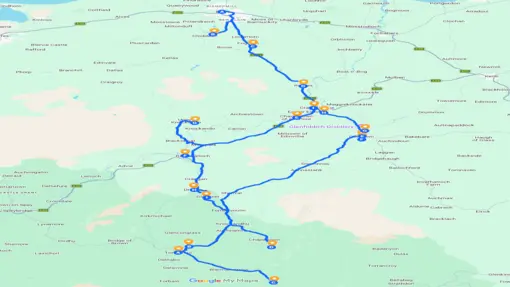
Phase 1: The Sacred Southbound Ascent
Elgin to Rothes (~20 mins total via A941)
The Sights:
- Birnie Kirk: One of the oldest continuously used places of worship in Scotland. This 12th-century Norman church served as the first cathedral for the Bishop of Moray.
- Millbuies Country Park: A “hidden gem” woodland park. The quiet loch is a haven for red squirrels and features a lovely circular walking path.
- Rothes: A classic whisky town. Look up to see the dramatic silhouette of Rothes Castle perched on the hill overlooking the distilleries.
Did You Know?A Papal Blessing: The ancient silver and copper bell housed at Birnie Kirk is local legend; it is believed to have been personally blessed by the Pope.
The First Seat of Power: Before Elgin Cathedral was built, Birnie Kirk served as the seat for the first four Bishops of Moray between 1107 and 1184.
A Symbolic Layout: The street plan of Rothes was designed in the shape of a Saltire (St. Andrew’s Cross), reflecting its roots dating back to 600 AD.
Ancient Stones: You can find a weathered Pictish symbol stone right by the gate of Birnie Kirk’s graveyard, featuring carvings of an eagle and a z-rod.
Whisky’s “Charcoal” Mark: You can spot a distillery warehouse from a distance by its charcoal-stained walls, a natural side effect of the whisky maturing inside.
Top Tips:
Step Into a Victorian Glen: Don’t just visit the distillery at Glen Grant; make sure to explore their 22 acres of stunning landscaped gardens and woodland paths.
Wildlife Watching: Keep your eyes peeled at Millbuies Country Park—it’s a fantastic spot to see red squirrels, roe deer, and swans around the loch.
Find the Hidden Castle: Head to the south end of Rothes to find the remains of Rothes Castle on the hill; it offers a great vantage point overlooking the High Street.
Norman Architecture: Look for the rounded Norman arch at the entrance to the chancel inside Birnie Kirk—it’s one of the finest surviving examples in a Scottish parish church.
Family Picnic Spot: Millbuies is perfectly set up for a full day out with barbecue areas, a play park, and a main trail that is easy to navigate around the water.
Family-Friendly Features: Millbuies is perfect for little explorers; the easy lakeside paths are great for spotting wildlife and “fairy houses” among the trees.
The Natural Break: Stop at The Station Hotel in Rothes for a morning scone or a coffee in their elegant, whisky-themed surroundings.
Want To Know More?
Follow the path of bishops and barons
BIRNIE KIRK
- The Kirk at Birnie is one of the few examples of surviving Norman architecture in a parish church in Scotland.
- It was the seat of the first four Bishops of Moray from 1107-1184 before the seat was permanently moved to Elgin.
- The site was used for worship long before the 12th century building was erected. It was probably the site of an early Celtic church dating back to the 6th century.
- A rounded Norman arch stands at the entrance to the chancel. Below the south window of the chancel, there is a caged enclosure which houses an ancient bell. It is thought that the bell, made of silver and copper, was personally blessed by the Pope.
- A Pictish carved stone stands by the gate leading to the graveyard. Although weathered, the traditional Pictish symbols of an eagle, notched rectangle and z-rod can still be seen.
MILLBUIES COUNTRY PARK
- One of the area’s most popular beauty spots, Millbuies Country Park, is an excellent outdoor environment for the whole family.
- Various trees surround the many paths that lead to picturesque views. The main trail circumnavigates the loch that is stocked with rainbow trout.
- Red squirrels, rabbits and roe deer are just some of the wildlife observed in the park, alongside the swans and moorhen that glide across the loch.
- Picnic tables and a barbeque and play area complement the car park and toilets.
ROTHES
- Inhabited as far back as 600 AD, the Rothes street plan forms a Saltire in honour of St. Andrew.
- The four distilleries’ pagoda rooftops and charcoal-stained bonded warehouses are evidence of its position at the heart of the world-famous Malt Whisky Trail and Speyside.
- The Glen Grant Distillery provides a perfect setting to sample the “water of life” for which the region is famous.
- Situated at the north end of Rothes, the distillery has an excellent visitor centre and 22 acres of gardens and glen. They can be accessed via a landscaped woodland path from the car park.
- At the south end of the village lies the remains of Rothes Castle. It was built on a hill by Peter de Pollok about 1200 AD to command traffic up and down this stretch of Speyside.
- Overlooking the High Street, the massive outer wall is the only fragment of the once magnificent castle.
Phase 2: Castles & Craftmanship
Rothes to Knockando (~30 mins via A941/A95/B9102)
The Sights:
- Aberlour: Home to the world-famous Walkers Shortbread. Take a short stroll from the village centre to see the Linn Falls, a stunning hidden waterfall.
- Ballindalloch Castle: Known as the “Pearl of the North,” this is one of Scotland’s few “living” castles. It hosts the world’s oldest herd of Aberdeen Angus cattle.
- Knockando Woolmill: A Victorian treasure that has been spinning and weaving local wool for over 200 years. It is a rare, working example of a “district” mill.
Did You Know?Global Shortbread Giant: Based right in Aberlour, Walkers Shortbread is the UK’s largest biscuit exporter and produces an incredible 60% of all shortbread exported from Scotland.
A Living Antique: The Knockando Woolmill is the oldest operating rural mill in Scotland, with generations of families maintaining its weaving traditions since 1784.
The Pearl of the North: Ballindalloch Castle has been the beloved home of the Macpherson-Grants since the 16th century and is considered one of the finest Scottish baronial castles.
Ancient Cattle Lineage: The cattle grazing on the Ballindalloch estate belong to the oldest Aberdeen Angus herd in the world.
A Bridge to the Past: The packhorse bridge in Aberlour was built before 1624 and once led to the ancient Kirk of St. Drostan.
Top Tips:
Experience Victorian Craft: Don’t just look at the Knockando Woolmill—listen for the rhythmic sounds of the original Victorian machinery that is still used to weave cloth today.
Taste a Local Legend: Visit the Aberlour Distillery near the Lour Burn to learn about their famous single-cask A’bunadh whisky.
Look for the Shot-Holes: When touring Ballindalloch Castle, keep an eye out for the small windows and defensive shot-holes in the 1845 Z-plan tower house.
Walk the High Street: Take a stroll down Aberlour’s mile-long, tree-lined High Street to find the town square—the perfect starting point for exploring the village and the River Spey.
Visit the Cemetery Ruins: Follow the packhorse bridge to the old cemetery to see the ivy-covered gable wall, the last standing remains of the old Kirk of St. Drostan.
Family-Friendly Features: The Ballindalloch Castle gardens feature a fantastic children’s adventure playground and plenty of space to see the famous cattle and ponies.
The Natural Break: The Knockando Woolmill Coffee Shop offers delicious home-baking with a view of the historic machinery and gardens.
Want To Know More
Step into a world of elegance and heritage
ABERLOUR
- Almost a mile long, a broad tree-lined High Street welcomes the passing motorist to this picturesque village.
- Towards the southwest end of the village are the square and the village focal point.
- The packhorse bridge can be found where the High Street crosses the Lour Burn. Built before 1624, it leads to an ivy-covered gable wall in the cemetery which was once part of the old Kirk of St. Drostan (Skirdustan).
- Aberlour A’bunadh is a well-known single-cask whisky produced by the Aberlour Distillery. The distillery is situated near the bridge and is open to visitors.
- The Parish Church sits on the side of the square nearest the River Spey. It was built to replace St Drostan’s Church as part of the new town development in 1812.
- The other end of Aberlour is home to a different but equally famous industry.
- Walkers Shortbread is the largest independent biscuit maker in the UK, producing 60% of all the shortbread exported from Scotland. Exporting to over 40 countries, it is also the UK’s largest biscuit exporter.
BALLINDALLOCH CASTLE
- Known as ‘The Pearl of the North, ’ Ballindalloch Castle is the home of the Macpherson-Grants since the 16th century.
- Today it is one of the finest surviving examples of a classic Scottish baronial castle.
- Extended and altered in 1845, the Z-plan tower house is an impressive tower pierced by small windows and shot-holes.
- Extensions to the castle were made in the 18th and 19th centuries and included the lower wing.
- Excellent fishing is provided by the Rivers Avon and Spey that run through the estate.
- The cattle that graze here belong to the oldest Aberdeen Angus herd in the world.
KNOCKANDO WOOLMILL
- Generations of families since 1784 have maintained the traditions of spinning and weaving in the oldest operating rural mill in Scotland.
- The Victorian machinery at the Knockando Mill is still in use today, and the unique sounds and smell of woven cloth provide a unique visitor experience.
Phase 3: The High Mountain Road
Ballindalloch to The Lecht (~40 mins via B9136/A939)
The Sights:
- Drumin Castle: Stand beneath the 14th-century tower house of the “Wolf of Badenoch,” overlooking the confluence of the Rivers Livet and Avon.
- The Packhorse Bridge: A relic of the region’s smuggling and trading past, these arched stone bridges were built to withstand the Spey’s fierce tributaries.
- Tomintoul: At 1,165ft, this is the highest village in the Highlands and the gateway to the Cairngorms National Park.
- “The Still” Viewpoint: A mirrored art installation on the A939 that perfectly reflects the vast, rolling landscape of the Glenlivet Estate.
- The Lecht Ski Centre: The summit of the pass. In summer, it offers mountain biking and alpine views; in winter, it is a hub for skiing and snowboarding.
- Scalan Seminary: A remote “secret college” in the Braes of Glenlivet where Catholic priests were clandestinely trained during the 18th century.
Did You Know?The Wolf’s Lair: Drumin Castle was the seat of Alexander Stewart, notoriously known as the “Wolf of Badenoch,” who famously razed Elgin Cathedral in 1390.
Highland Heights: Sitting at 354m above sea level, Tomintoul holds the title of the highest village in the Scottish Highlands.
Smugglers’ Secret: The ancient Packhorse Bridge over the River Livet was once a vital route for whisky bootleggers transporting illicit spirits through the glen.
Underground Mystery: Knock Earth House is a stone-lined underground chamber dating back to the late Bronze Age (1200 BC), though its exact purpose remains a mystery.
A Secret Sanctuary: For much of the 18th century, the remote Scalan Seminary was the only place in Scotland where men could secretly train for the Catholic priesthood.
Reflected Beauty: ‘The Still’ viewpoint near Tomintoul features mirrored interior walls designed to reflect the surrounding Highland landscape.
Top Tips:
Mind the Gap: While you can visit the historic Packhorse Bridge via the B9008 car park, remember it is unstable and cannot be crossed.
Outdoor Adventure: Make the most of the Glenlivet Estate, which offers over 100 miles of bike and walking trails, plus clay pigeon shooting and horse riding.
Year-Round Fun at The Lecht: Visit in winter for skiing and snowboarding, or head there in summer to tackle the downhill mountain bike trails.
Perfect Picnic Spot: Drumin Castle sits on a rocky bluff overlooking the confluence of the Rivers Livet and Avon, offering a dramatic backdrop for a break.
Explore the Remote: If you’re looking for true isolation, Tomintoul is the gateway to a vast area with no major development for nearly 40 miles to the southwest.
Family-Friendly Features: The Tomintoul Adventure Playground is a great stop to stretch legs, and the “Still” installation is a fun, interactive spot for family photos.
The Natural Break: The Old Fire Station in Tomintoul is a cosy spot for a hearty Highland lunch or a warm hot chocolate.
Want To Know More?
Ascend to the roof of the Highlands
DRUMIN CASTLE
- Standing on a rocky bluff, Drumin Castle overlooks the confluence of the River Livet and the River Avon and is protected by them on its northeastern and northwestern sides.
- In 1372, Alexander Stewart was granted the land by his father, King Robert II.
- Drumin Castle was probably built in 1376 and stood in an ideal defensive location which may have been fortified as far back as the Iron Age.
- On 17th June 1390, Alexander Stewart destroyed Elgin Cathedral and much of the town—an act in keeping with his reputation as the Wolf of Badenoch.
PACKHORSE BRIDGE
- The Packhorse Bridge is thought to have been built at the same time as nearby Blairfindy Castle.
- Hundreds of years old, it’s the oldest surviving structure to cross the River Livet. It helped the transportation of whisky by early bootleggers.
- In 1829, The Muckle Spate swept away one of the arches. The two surviving arches do, however, give a sense of the original structure.
- A small car park off the B9008 provides access to the bridge; however, the bridge is unstable and can no longer be crossed.
KNOCK EARTH HOUSE
- An underground structure dating from the late Bronze Age (1200 BC), the site is an ancient listed monument.
- Whilst the origin of Knock Earth House is uncertain, it is an underground chamber that is stone lined and may have been a souterrain or “earth house”.
TOMINTOUL
- At a height of 354m, Tomintoul is the highest village in the Highlands.
- The village remains relatively remote with nothing, to the southwest, more developed than the odd track for nearly 40 miles.
- The 4th Duke of Gordon built the village in 1776 to house many dispersed settlements on his estate.
- The new village offered improved housing and made tackling whisky smuggling and cattle reiving easier.
- The town is ideal for exploring the Glenlivet Estate (a vital part of the Malt Whisky Trail) and the northeastern Cairngorms.
- Bike and walking trails are within easy access on the estate, which covers more than 100 miles.
- The estate also offers the opportunity to enjoy clay pigeon shooting, fishing and horse riding.
‘THE STILL’ VIEWPOINT’
- A feature on the Scots Road Scenic Route, ‘The Still’ is a box-like structure that forms a viewpoint just outside Tomintoul.
- The installation has two open ends, and the mirrored interior walls reflect the landscape.
THE LECHT
- One of Scotland’s most innovative snowsport centres, the Lecht is small but perfectly formed.
- When conditions allow, freestylers can access a skills park. Slalom poles and timing are available for sports skiers on the race piste.
- A skills park and two downhill mountain trails for Mountain Bikes provide activities in the summer.
SCALAN SEMINARY
- One of the most significant sites of historical interest in Moray.
- After the Reformation of 1560, the Catholic Church almost died out in Scotland.
- To avoid persecution, a college for priests was established in 1716. A remote spot at the foot of the Ladder Hills in the Braes of Glenlivet was chosen for the college.
- It was the only place in Scotland, for much of the 18th century, where young men could be trained to be priests.
Phase 4: The Whisky Capital & The Iron Bridge
The Lecht to Elgin via Dufftown (~50 mins via A939/B9008/A941)
The Sights:
- Dufftown: The “Whisky Capital of the World.” Home to iconic names like Glenfiddich and Balvenie, the town’s architecture reflects its Victorian industrial boom.
- Mortlach Kirk: One of Scotland’s oldest Christian sites, featuring ancient Pictish stones and a rich, atmospheric graveyard.
- Balvenie Castle: A formidable 13th-century curtain-wall castle. Explore the massive stone walls that once housed the Earls of Atholl.
- Craigellachie & The Bridge: End your tour at Thomas Telford’s 1814 cast-iron masterpiece. Walk across the span for a breathtaking view of the River Spey.
Did You Know?Whisky Capital: Dufftown produces more whisky than any other town in Scotland and is home to the world-famous Glenfiddich Distillery.
Viking Victory: Mortlach Kirk stands near the site where King Malcolm II defeated a massive Viking force in 1010.
Body Snatcher Defense: The graveyard at Mortlach Kirk features a historic watchhouse, built specifically to guard against 19th-century body snatchers.
Engineering First: Opened in 1814, the Craigellachie Bridge is Scotland’s only surviving iron bridge and was a revolutionary design by Thomas Telford.
Barrel Power: The Speyside Cooperage is a titan of industry, repairing and building over 100,000 barrels every single year.
Ancient Roots: Mortlach Kirk, founded in 566 AD, is one of the oldest Christian settlements in Scotland, with some surviving parts dating back to the 8th century.
Top Tips:
Catch the Games: Plan your visit for the last Saturday in July to experience the Dufftown Highland Games, featuring massed pipe bands and heavy events.
Ride the Rails: Take the seasonal Keith and Dufftown Railway for a scenic 45-minute journey between the two historic towns.
Marvel at Macallan: Don’t miss the new Macallan Distillery; its striking contemporary architecture is built directly into the landscape of the Easter Elchies estate.
Explore the Fortress: Visit Balvenie Castle to see its original iron “yett” (gate) and explore the massive vaulted medieval bakery on the ground floor.
Find the Pictish Stones: Look closely at the stained glass and the vestibule at Mortlach Kirk to find ancient carvings and depictions of Pictish symbol stones.
Walk the Iron Bridge: Visit the iconic Craigellachie Bridge for a spectacular photo opportunity of Thomas Telford’s finest ironwork spanning the River Spey.
Family-Friendly Features: The ruins of Balvenie Castle are excellent for exploring; the wide-open courtyard and dark passages provide a safe sense of adventure for older kids.
The Natural Break: Visit The Highlander Inn in Craigellachie for a traditional pub atmosphere or grab a riverside snack at the Craigellachie Filling Station (a local favourite for its bakes).
Want To Know More?
Step into the beating heart of Speyside
DUFFTOWN
- At the foot of the Conval Hills and on the banks of the River Fiddich, Dufftown is at the heart of Speyside.
- The roads into and through Dufftown intersect at the square with its distinctive clock tower.
- Dufftown is home to the Glenfiddich Distillery, the central point for the Malt Whisky Trail and founders of the Spirit Of Speyside whisky festival. It produces more whisky than any other town in Scotland.
- The Dufftown Highland Games are held on the last Saturday in July and offer a taste of something Scottish for everybody.
- The games offer a complete programme of Light and Heavy Events, Massed Pipe Bands, Highland Dancing, Hill Races, fun for the entire family and much more.
- Just beyond Glenfiddich Distillery on the road to Craigellachie is the old Dufftown Railway Station.
- The Keith and Dufftown Railway runs seasonal services for the 45 minute trip to Keith.
- Two miles south of Dufftown is Auchindoun.
- In the 15th century, a tower house was constructed, as part of Auchindoun Castle, on the site of an Iron Age hill fort.
MORTLACH KIRK
- Founded in 566 AD by St Moulag, the Kirk is one of the oldest Christian settlements in Scotland.
- Whilst much of what can be seen today dates to the 12th century, the earliest parts of the church date to the 8th century.
- Pictish stones are depicted on one of the stained glass windows, and the image of a beast is carved in the Pictish stone in the vestibule.
- To guard against body snatchers, a watchhouse was positioned in the graveyard.
- The Battle Stone, a late Pictish symbol stone, can be found in the lower graveyard.
- Mortlach itself is the site where in 1010, King Malcolm II defeated a considerable force of Vikings on the hill opposite the Kirk.
BALVENIE CASTLE
- A 13th century fortress, Balvenie Castle, can be found immediately north of the town centre of Dufftown.
- Built by the 4th Earl of Atholl, a three-storey 16th century tower house stands within a high curtain wall.
- A projecting round tower flanks the entrance, which still has its original yett.
- Whilst the upper floors are ruined, it is still possible to see the great hall with a pointed vault and the massive vaulted cellar and bakery on the ground floor.
- The site commands the mouths of Glen Rinnes and Glen Fiddich along with routes to Huntly, Keith, Cullen and Elgin and was strategically significant.
CRAIGELLACHIE
- The name means “rocky hill”, and the village dates back to at least 1750.
- The village is located on a cliff above the River Spey and the site of a ferry across the Spey.
- The Craigellachie Distillery can be found in the village, and the Macallan Distillery is situated on the other side of the River Spey.
- The Easter Elchies estate is home to the new Macallan Distillery and visitor centre, and the architecture is contemporary and striking.
- The buildings are cut into the slope of the land, which has been classified as an ‘Area of Great Landscape Value’, minimising the visual impact on the Speyside landscape.
- The Speyside Cooperage is just outside Craigellachie on the Dufftown road.
- The cooperage repairs and builds over 100,000 barrels a year, a critical element of the whisky distilling industry.
CRAIGELLACHIE BRIDGE
- The iconic Craigellachie Bridge is one of Moray’s most photographed structures and is one of the finest examples of Thomas Telford’s work.
- Opened in 1814, it carried traffic over the River Spey until the early 1970s when a new road bridge was built downstream.
- The bridge was revolutionary for its time, has a single 150ft span, and is Scotland’s only surviving iron bridge.
Best For Photographers: Top 3 Vantage Points
If you’re looking to capture the “perfect shot” of the Highlands, keep your camera ready for these three iconic Speyside locations:
1. The Mirrored Frames at “The Still” Viewpoint
- The Shot: The sleek, mirrored art installation perfectly frames the expansive, purple-hued heather and rolling peaks of the Glenlivet Estate.
- Pro Tip: Position yourself to capture the reflection of the sky within the mirrors. On a day with dramatic cloud cover, the contrast between the metal and the wild landscape creates a stunning, surrealist composition.
2. The Iron Span of Craigellachie Bridge
- The Shot: A low-angle view of Thomas Telford’s 1814 cast-iron arch as it leaps across the rushing River Spey, framed by the steep, wooded cliffs.
- Pro Tip: This is a long-exposure dream. Use a tripod and a neutral density (ND) filter to blur the movement of the Spey into a silky white ribbon, contrasting with the dark, intricate lattice-work of the historic bridge.
3. The Linn Falls (Aberlour)
- The Shot: A hidden, moss-covered waterfall where the water cascades over dark rocks into a deep, clear pool, surrounded by ancient woodland.
- Pro Tip: Visit in autumn (late October). The vibrant reds and golds of the turning beech trees overhanging the falls create a rich, saturated palette that looks incredible against the dark, wet stone.
Best For Wildlife: Top 3 Nature Spots
Speyside is a haven for Scotland’s “Big Five.” Keep your binoculars ready as the landscape shifts from lush river valleys to high alpine tundra.
1. Red Deer at The Lecht Pass
- The Sighting: As you climb the A939 towards the ski centre, look to the high ridges. This is prime territory for Britain’s largest land mammal.
- Pro Tip: Early morning or dusk is the best time to see them. During the autumn “rut” (September/October), you can often hear the powerful roars of the stags echoing across the mountain passes.
2. Golden Eagles in the Braes of Glenlivet
- The Sighting: The remote, rugged skies above Scalan and the surrounding Glenlivet Estate are the hunting grounds for these majestic birds of prey.
- Pro Tip: Scan the “skyline” of the ridges rather than the open blue. Look for a large, dark silhouette with long, broad wings and “fingered” wingtips soaring on the thermals.
3. Red Squirrels at Millbuies Country Park
- The Sighting: The tall pines surrounding the loch are a stronghold for the native Red Squirrel. They are active year-round and much smaller and shyer than their grey cousins.
- Pro Tip: Walk quietly along the woodland trails. Listen for the scratching of claws on bark or the sound of pinecone scales dropping to the forest floor—sure signs that a squirrel is feeding overhead.
Navigation & Visitor Tips
- The Snow Road: This route follows parts of the A939, one of the highest roads in Britain. Check weather reports in winter, as the Lecht pass is often the first to close.
Wildlife: Keep your eyes peeled for Golden Eagles and Red Deer as you climb toward Tomintoul.
Accessibility: Ballindalloch Castle gardens and the Knockando Woolmill visitor centre provide excellent accessibility for all visitors.
Let’s Start Something new Say Hello!
Your visitor experience is important to us. We can help with the information that you might need, before and during your visit, to make informed choices.